
OpenRouter's 4 September model wave: GPT-6 Astra, Grok 4.3 and specialist routes
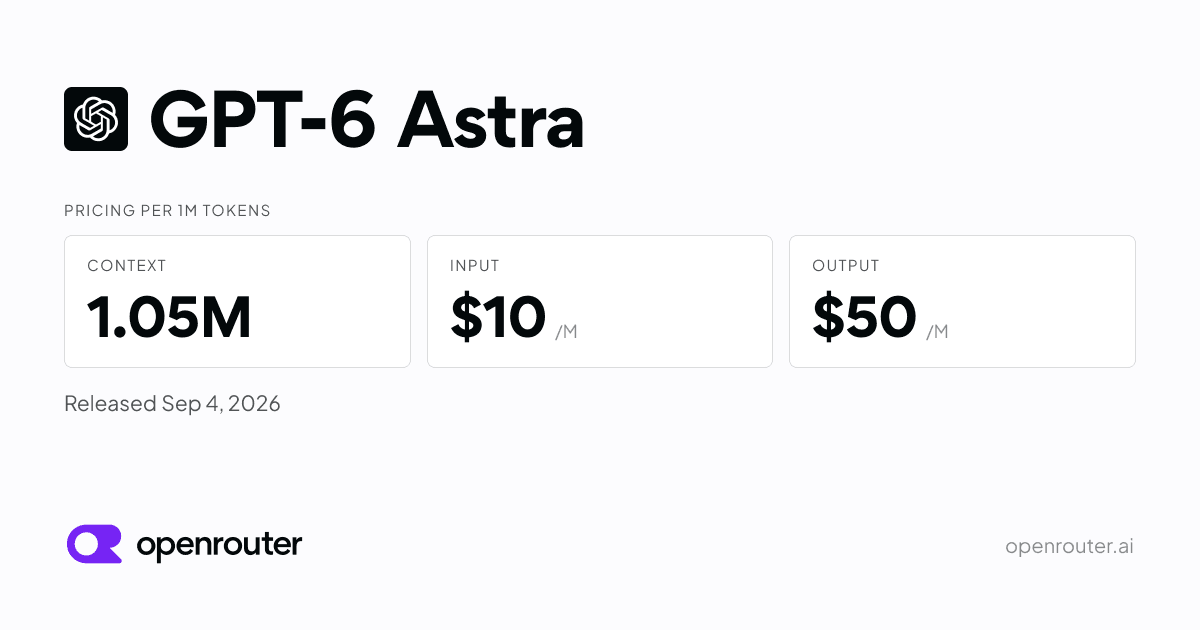
AIMI recorded four distinct model routes arriving on OpenRouter during 4 September 2026. GPT-6 Astra led the late-evening wave, while Grok 4.3, Ling 3.0 Flash Sante and NVIDIA Nemotron 3.5 Content Safety appeared earlier.
Synthesized via Fish Audio S2.1 Pro in British English. Natural editorial summary, not verbatim reading.
Key Takeaways
- check_circleOpenRouter route observations formed a clear same-day sequence on 4 September: Nemotron 3.5 Content Safety, Grok 4.3, Ling 3.0 Flash Sante, then GPT-6 Astra.
- check_circleThe gap from Nemotron to Grok was 1 hour, 36 minutes and 9 seconds. The gap from Ling to GPT-6 Astra was 1 hour, 52 minutes and 14 seconds.
- check_circleOpenAI's official API documentation confirms GPT-6 Astra. SpaceXAI's documentation confirms Grok 4.3. NVIDIA dates Nemotron 3.5 Content Safety to March and June, so its 4 September event was provider availability rather than a new NVIDIA release.
- check_circleAIMI saw OpenRouter routes, not a single shared launch. The timestamps show sequence, not causation, and provider capabilities still need testing on the exact route.
Four route events, one busy day
The model-release desk recorded four distinct canonical model events on 4 September 2026. AIMI first saw `nvidia/nemotron-3.5-content-safety` at 01:58:50 SAST, then `x-ai/grok-4.3:batch` at 03:34:59, exactly 1 hour, 36 minutes and 9 seconds later.
The next notable route was `inclusionai/ling-3.0-flash-sante:free` at 20:38:43 SAST. GPT-6 Astra and its Pro variant followed at 22:30:57, 1 hour, 52 minutes and 14 seconds later. The GPT batch routes appeared at 23:19:02 and 23:35:04. These are endpoint first-seen times, not automatic proof of maker announcements or general availability.
GPT-6 Astra was the late headline
OpenAI's API documentation describes GPT-6 Astra as its most capable model for complex reasoning, coding, computer use, research and document creation. The page lists a 1,050,000-token context window, 128,000 maximum output tokens, image input, reasoning controls and support for the Responses API, tools and structured outputs.
OpenRouter first created the standard and Pro route records at 22:13:58 and 22:13:55 SAST, then AIMI observed both routes at 22:30:57. The Pro identifier is the same underlying model with `reasoning.mode` set to `pro`; the batch variants are lower-priced processing routes. We found no separate OpenAI announcement timestamp in this batch, so the article treats 4 September as an OpenRouter availability event backed by current OpenAI documentation, not as a claimed same-day OpenAI launch.
Grok 4.3 arrived earlier
SpaceXAI's model documentation lists Grok 4.3 with text and image input, a one-million-token context window, reasoning, structured outputs, function calling and Batch API support. OpenRouter exposes the standard route as `x-ai/grok-4.3` and the batch route as `x-ai/grok-4.3:batch`.
AIMI first saw the batch route at 03:34:59 SAST. That makes Grok 4.3 the second major route event in this batch, not evidence that it was released in response to NVIDIA or any other company. The ordering is useful context; it does not establish causation.
Two specialist routes filled the middle of the day
NVIDIA's official Nemotron 3.5 Content Safety page dates the model to 16 March 2026 on Hugging Face and NGC, and 2 June 2026 on Build.NVIDIA.com. It is a 4-billion-parameter multimodal safety model based on Gemma 3 4B. OpenRouter availability on 4 September is therefore a route addition, not a fresh NVIDIA release. The catalogue also currently exposes a zero-price variant, which should be treated as a provider offer that can change.
OpenRouter also listed `inclusionai/ling-3.0-flash-sante:free` at 20:38:43 SAST. This is a health and medicine-focused route with a 262,144-token context window in the provider metadata. The batch contains no verified InclusionAI model-card or weights timestamp for this Sante variant, so it is reported as an OpenRouter route addition rather than an official InclusionAI launch.
What the timestamps do and do not prove
The sequence makes 4 September a useful availability snapshot: the first route appeared at 01:58:50 SAST, the second 1 hour, 36 minutes and 9 seconds later, and the final major route 1 hour, 52 minutes and 14 seconds after the specialist Ling route. There were no earlier verified release packages in the input for this SAST day.
Provider-created time, endpoint first-seen time, maker announcement, general availability and weights publication are different events. The AZ Labs model index keeps those dates separate. Before changing a production default, test the exact route, confirm current pricing and review the provider terms. The AZ Labs AI Gateway can keep those route changes behind one integration layer while you compare them.
Frequently Asked Questions
Did OpenAI, SpaceXAI, NVIDIA and InclusionAI launch a coordinated wave?
No. AIMI records a sequence of provider route observations. The timestamps show when OpenRouter first exposed routes, not a coordinated launch or a response between companies.
What is the exact GPT-6 Astra route?
The standard route is openai/gpt-6-astra. OpenRouter also lists openai/gpt-6-astra-pro, openai/gpt-6-astra:batch and openai/gpt-6-astra-pro:batch. The Pro route is the same underlying model with a Pro reasoning mode.
Was Nemotron 3.5 Content Safety newly released on 4 September?
No. NVIDIA dates the model to March 2026 on Hugging Face and NGC, and June 2026 on Build.NVIDIA.com. The 4 September event was its OpenRouter route appearance.
Is Ling 3.0 Flash Sante an official InclusionAI release?
The batch verifies an OpenRouter free route, but it does not contain a verified InclusionAI model-card or weights timestamp for this Sante variant. Treat the maker release date as unknown until that evidence is found.
Should I use these routes in production?
Not without testing. Provider metadata can change, and capabilities, pricing, rate limits and data handling belong to the route you call. Test the exact identifier and keep a fallback.